
Concert I / Friday 4 December 2026 / 8 pm / Alte Feuerwache Köln
Roman Pfeifer / Kammerelektronik
Foxhole Radio (2026, world premiere), 30 min, viola and electronics, 2‑channel. Viola: Annegret Mayer-Lindenberg
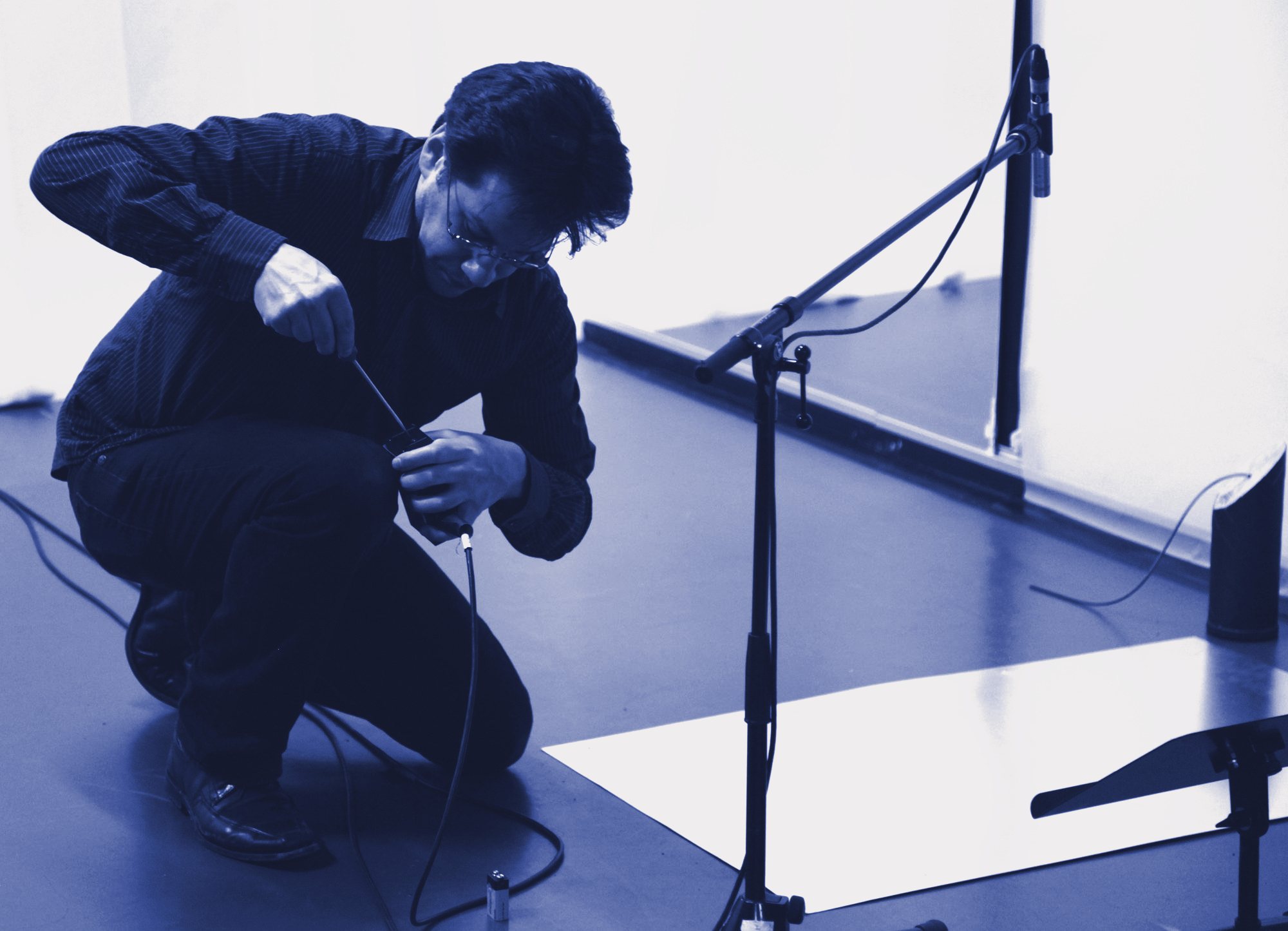
Work
Foxhole Radio
The foxhole radio is a makeshift radio built from everyday materials. It is named after the foxhole, a defensive fighting position of the Second World War. And although these radios were built to pick up a little music from the nearest station, most of what they received was probably other signals (hiss, crackle, hum and so on). This world of sound, only poorly described as interference between stations, is also what the first radio listeners heard, decades before radio was invented. Like Thomas Watson, assistant to Alexander Graham Bell and receiver of the first telephone call, who in the night hours of the 1870s heard natural radio through the telephone, over a long metal line that served as an antenna before antennas were invented. “I used to spend hours at night in the laboratory listening to the many strange noises in the telephone.” Natural sounds are familiar to us, natural signals are not. Everyone knows how birds sing, but very few people have heard the whistling of the magnetosphere. And although humans act as if they had invented electricity, radio waves are natural phenomena, produced by electrical storms, thunderstorms, solar winds and other astronomical phenomena.
Today, however, the task is to explore the radio as a simple tool for understanding electromagnetism as nature, as artistic raw material in an environment of signals. It is about taking electromagnetism out of its modern life in telephone lines, radios, power sockets and so on, regarding it as a natural resource, and exploring the aesthetic experience of electromagnetism as a descendant of the Aeolian.
“The sky is only an antenna with a wide range” (André Breton).
Biography
Roman Pfeifer
Roman Pfeifer composes, stages, produces and does research. His field of work lies between chamber music and electronics. He collaborates with artists from many disciplines, working in a process-based way that involves sound, instrument, movement, voice, light, space and gaze. The company Kammerelektronik, founded in 2012, is at the centre of his creative work; for it he conceives and composes concert performances in chamber music format. Roman Pfeifer studied composition with Nicolaus A. Huber and Dirk Reith at the Folkwang University of the Arts in Essen, where he has taught composition, analysis and notation since 2004. He lives and works as a composer in Cologne.
Annegret Mayer-Lindenberg
Annegret Mayer-Lindenberg studied music with viola as her main subject in the Netherlands with Gisella Bergman and Garth Knox. She is very active in contemporary chamber and ensemble music and is a member of Ensemble Garage and of the company Kammerelektronik. In 2025 she completed her composition studies with Johannes Schöllhorn in Freiburg.
On the same evening
Thomas Lehn
raumen (2026, world premiere), 30 min, analogue synthesizer, 4‑channel
Kyoka
Phantom Field (2026, world premiere of the 8‑channel version), 30 min, live electronics, 8‑channel